
 Furnace & heating
 AC repair
 Heat pumps
 Ductless mini splits
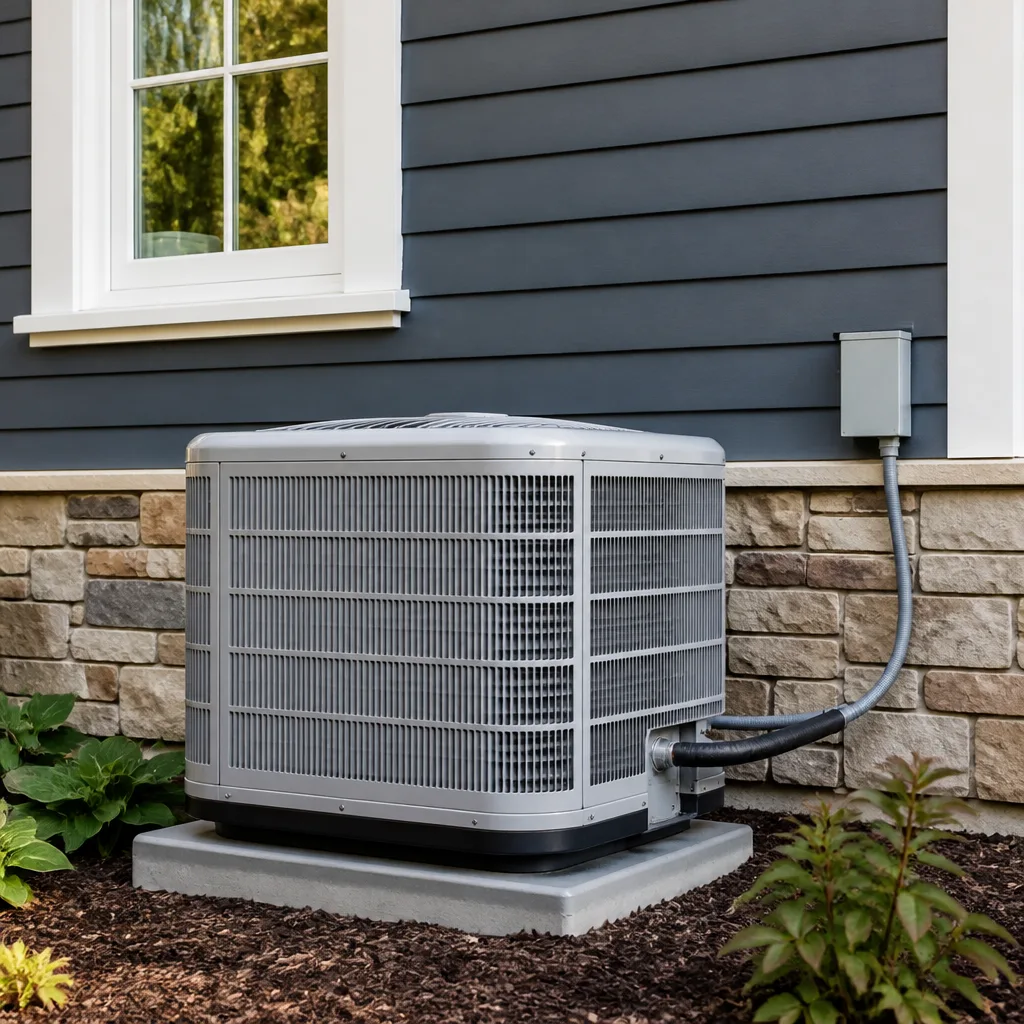 Carrier
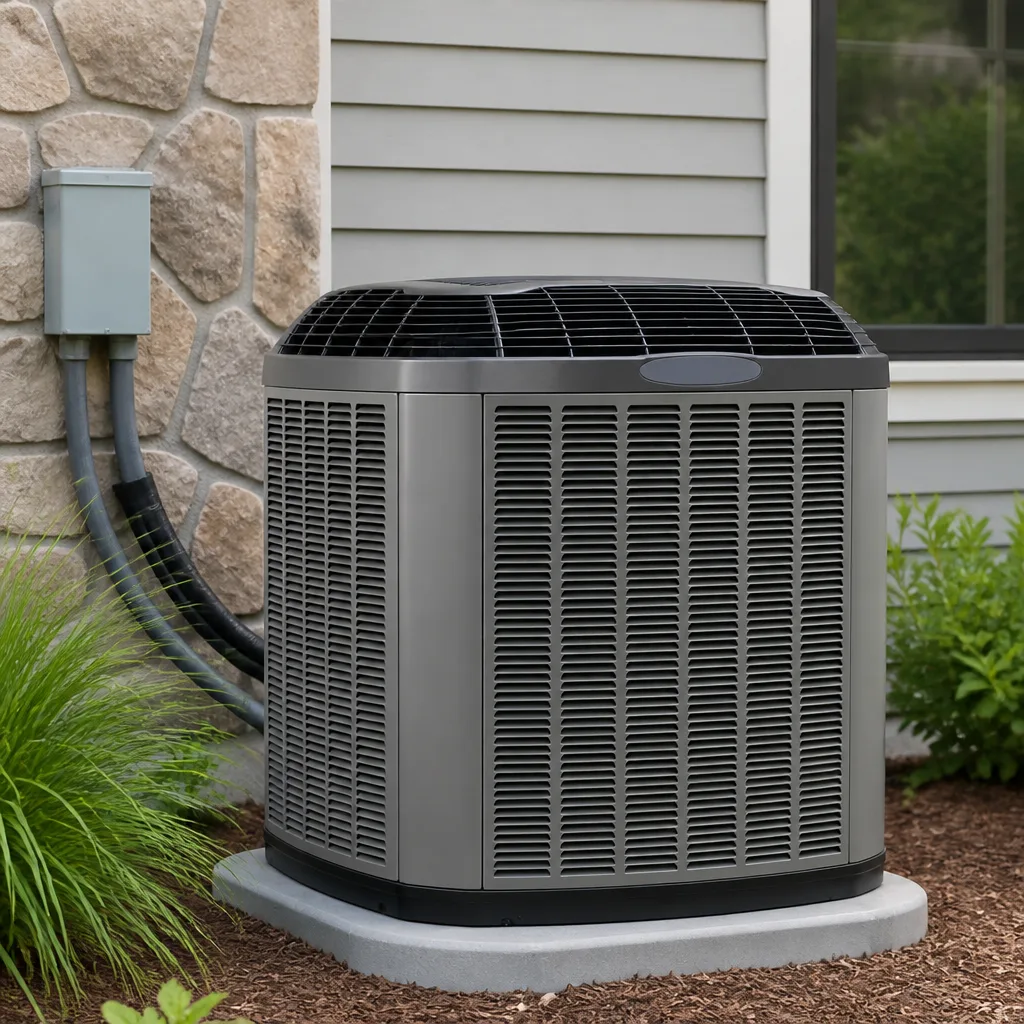 Trane
Trane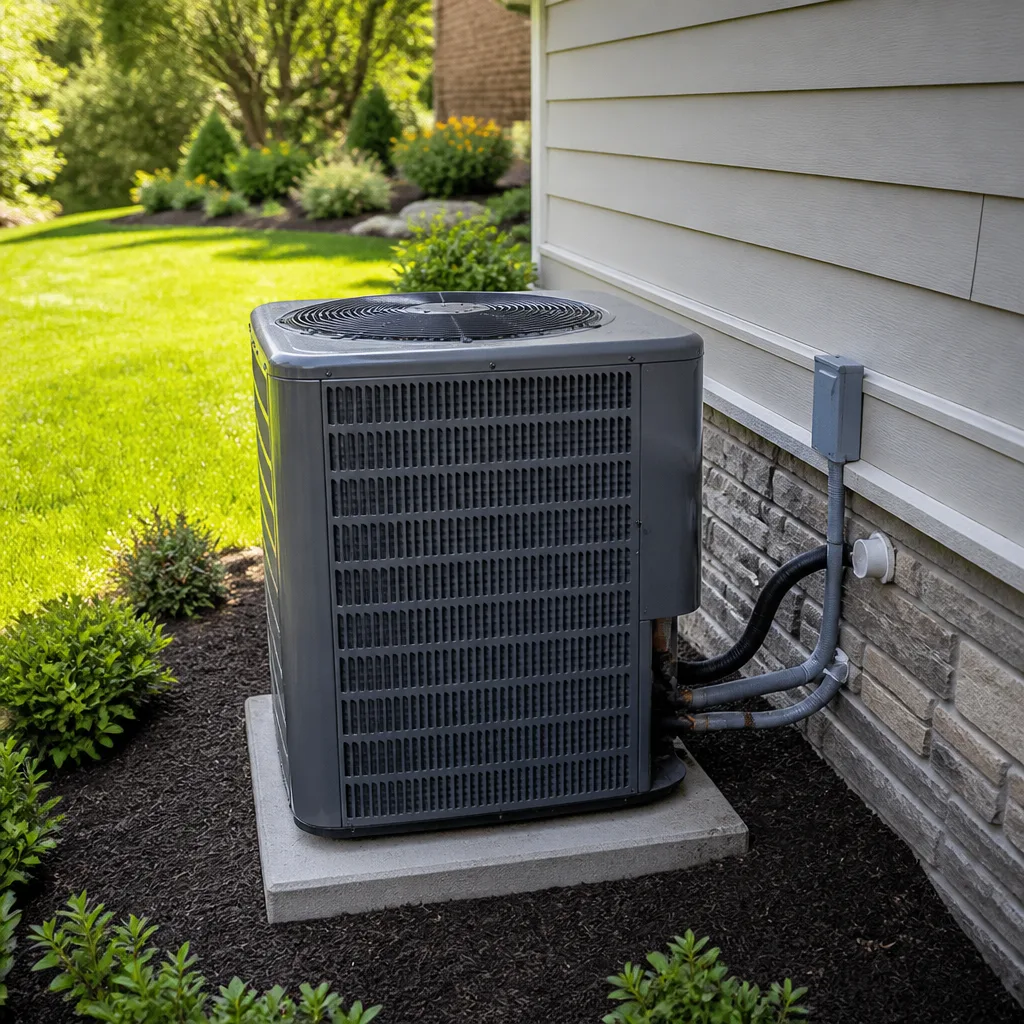 Goodman
Seasonal tune-up and full diagnostic on your Carrier, Trane, or Goodman system - readings shown to you before any repair is proposed
Diagnosis first, numbers second - you approve the repair price before a single part goes in.
Get your free estimateRheem Capacitor Replacement: The Houston Owner’s Guide
Rheem capacitor replacement in Houston typically runs $150 – $375 installed, depending on the capacitor’s microfarad rating, voltage spec, and whether it’s a single or dual-run unit. We stock Rheem-compatible capacitors on our trucks and can usually complete the swap same-day in a single visit. Most Houston homeowners discover a failed capacitor because the AC’s outside fan won’t spin up while the compressor hums and trips its breaker, or the system short-cycles only during the hottest part of the afternoon. It’s the single most common midsummer AC failure we see across the city, from Katy to Clear Lake to The Woodlands.
Here’s the thing about capacitors: they fail without much warning. One Tuesday your Rheem air conditioner cools fine. By Thursday, it’s blowing warm air and making a clicking sound a few seconds after the thermostat calls for cooling. That’s the capacitor giving up, and it happens more often in Houston because our heat forces the part to cycle under load repeatedly. If you’re hearing a hum that turns into a click, or the condenser fan only runs when you give it a push with a stick (please don’t do that), keep reading. We’ll walk you through exactly what’s going on, what it should cost, and how to get it fixed tonight.
Which Rheem Models This Applies To
Rheem uses two main capacitor configurations across its residential lineup. The Classic Series and Prestige Series condensers, along with many Rheem packaged units, typically run a dual-run capacitor that handles both the compressor and the condenser fan motor from a single cylindrical component. These are round or oval, and you’ll almost always see a rating like 45/5 µF ±5% printed directly on the side of the metal can. That 45/5 means 45 microfarads for the compressor side, 5 microfarads for the fan side. If you just look at the label on your old capacitor, you’ll have the exact spec we need to match it.
One compatibility gotcha that catches Houston homeowners off guard: Rheem’s higher-efficiency units, especially the two-stage Prestige models, sometimes use a separate hard-start capacitor or a start capacitor paired with a potential relay. If you see a black plastic relay wired next to a second capacitor in your condenser cabinet, that’s a start-assist setup. It’s not an optional upgrade on those units. Swapping the wrong capacitor in that configuration can actually damage the compressor, so matching the spec matters more than you’d think. We match by microfarad rating, voltage (370V vs 440V), and physical dimensions so the replacement seats correctly on the mounting bracket.
On the OEM-versus-aftermarket question: Rheem-branded capacitors are solid, but so are the AmRad and Titan-brand aftermarket units we stock alongside them. The aftermarket versions often carry a longer rated service life at the same or better price. What matters more is that the capacitor is rated for the same microfarads and at least the same voltage as the original. We’ll show you the old part and the new one side by side before we install anything, so you can see exactly what you’re paying for.
Styles & brands we work with
Signs Your Rheem Capacitor Replacement Is Failing
- The outdoor fan isn’t spinning, but you hear a low hum. The capacitor has lost enough capacitance to drop below what the fan motor needs to start. In this state, the condenser can’t reject heat, so the compressor will overheat and trip its thermal overload within minutes. In a Houston July, that sequence can repeat eight or ten times a day.
- AC works in the morning, quits by 3:00 p.m. Capacitors are temperature-sensitive. When the side of your house bakes in direct afternoon sun, a marginal capacitor loses efficiency. That’s why so many Houston AC failures happen at the exact hottest moment of the day, and why “works in the morning, dead by dinner” is a classic capacitor tell.
- The system starts, runs three minutes, shuts off, restarts. That’s short-cycling, and when it’s the capacitor failing rather than a refrigerant charge issue, it happens because the compressor can’t maintain rotation under load. It’s hard on the compressor, and our technicians can often spot the capacitor’s bulging top before they even touch a meter.
- You have to nudge the fan blade with a stick to get it going. We get calls about this exact scenario a few times every summer. The capacitor is no longer providing the starting torque, so the fan needs physical help to overcome inertia. It’s also genuinely dangerous: spinning fan blades and a stick are a bad combination, and the same trick doesn’t work when the compressor is trying to start.
- You see a bulged or leaking capacitor. If you shut off the breakers and look through the condenser’s top grille, a failed capacitor often shows a domed top instead of a flat one, or a small amount of oily fluid at the base. That’s dielectric fluid, and when it leaks out, the capacitor is done. No resetting or cleaning will bring it back.
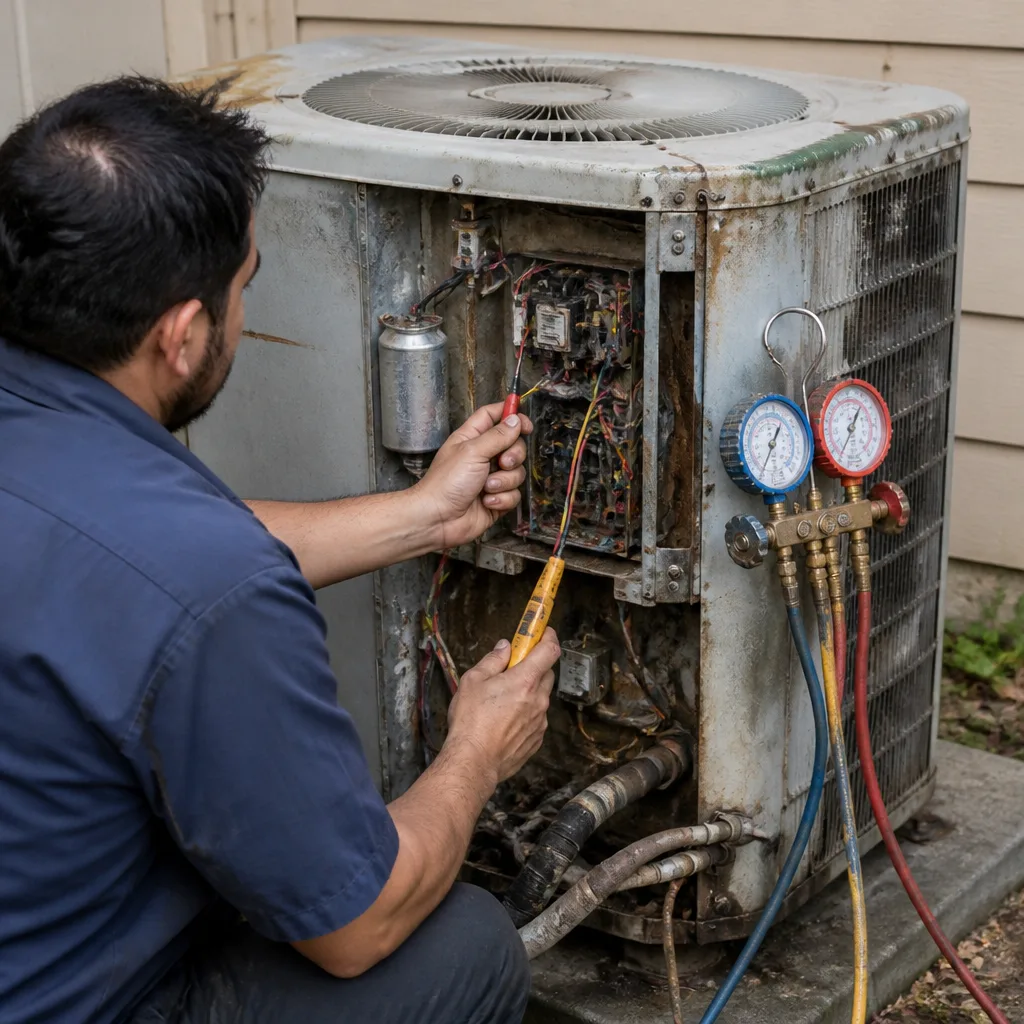
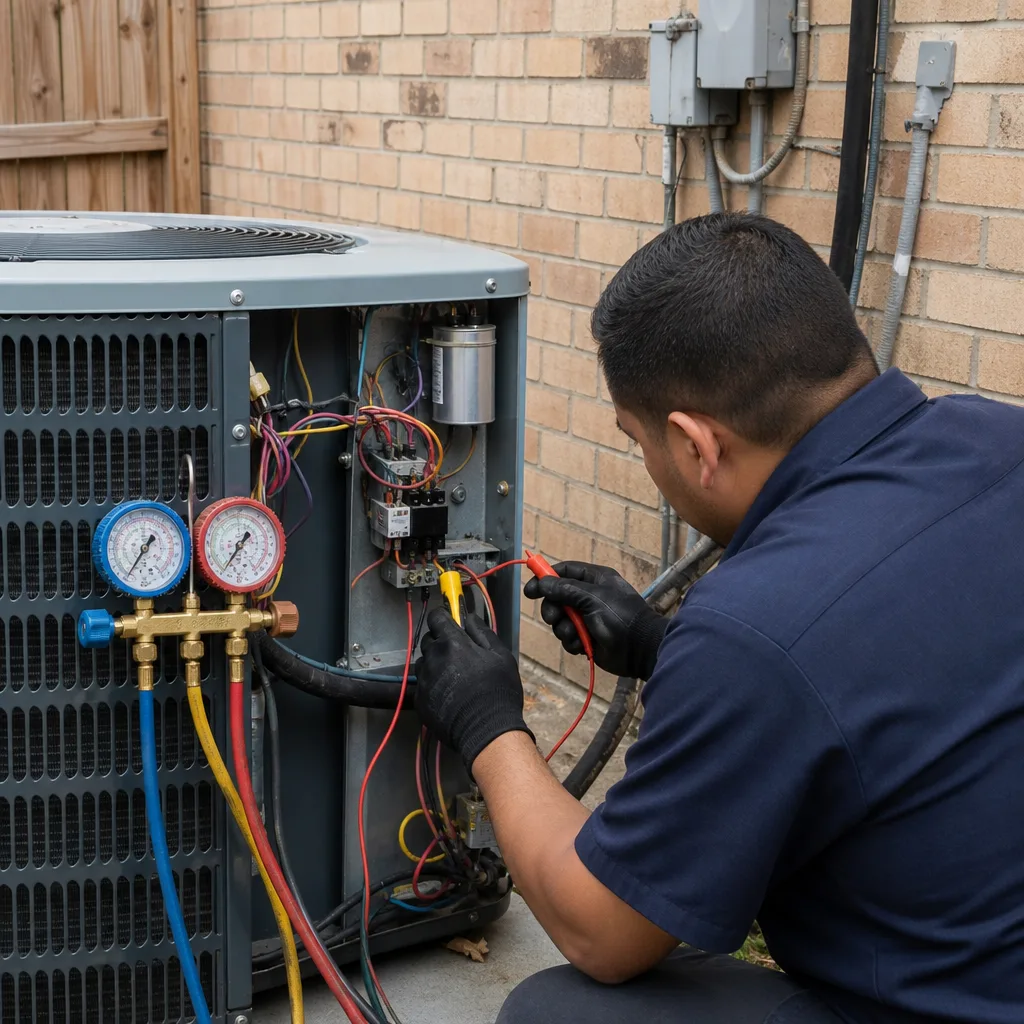
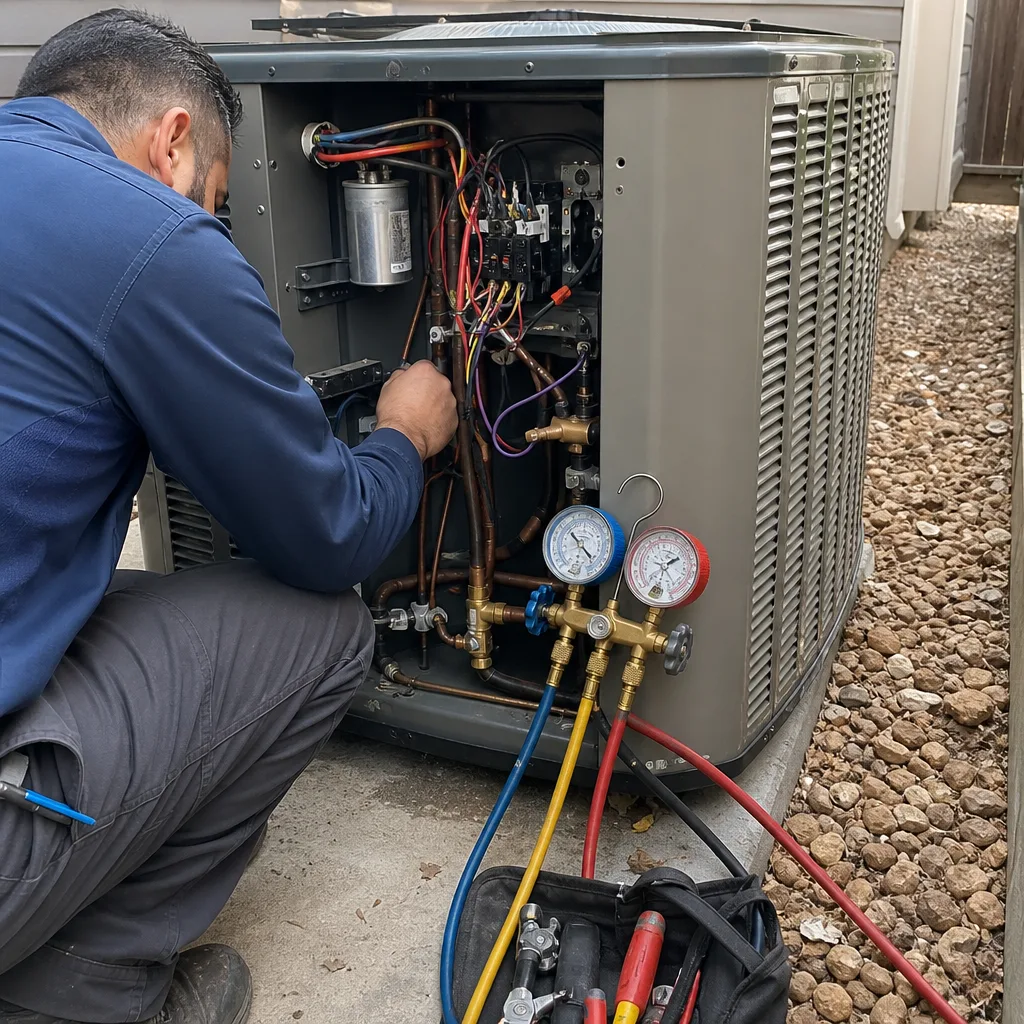
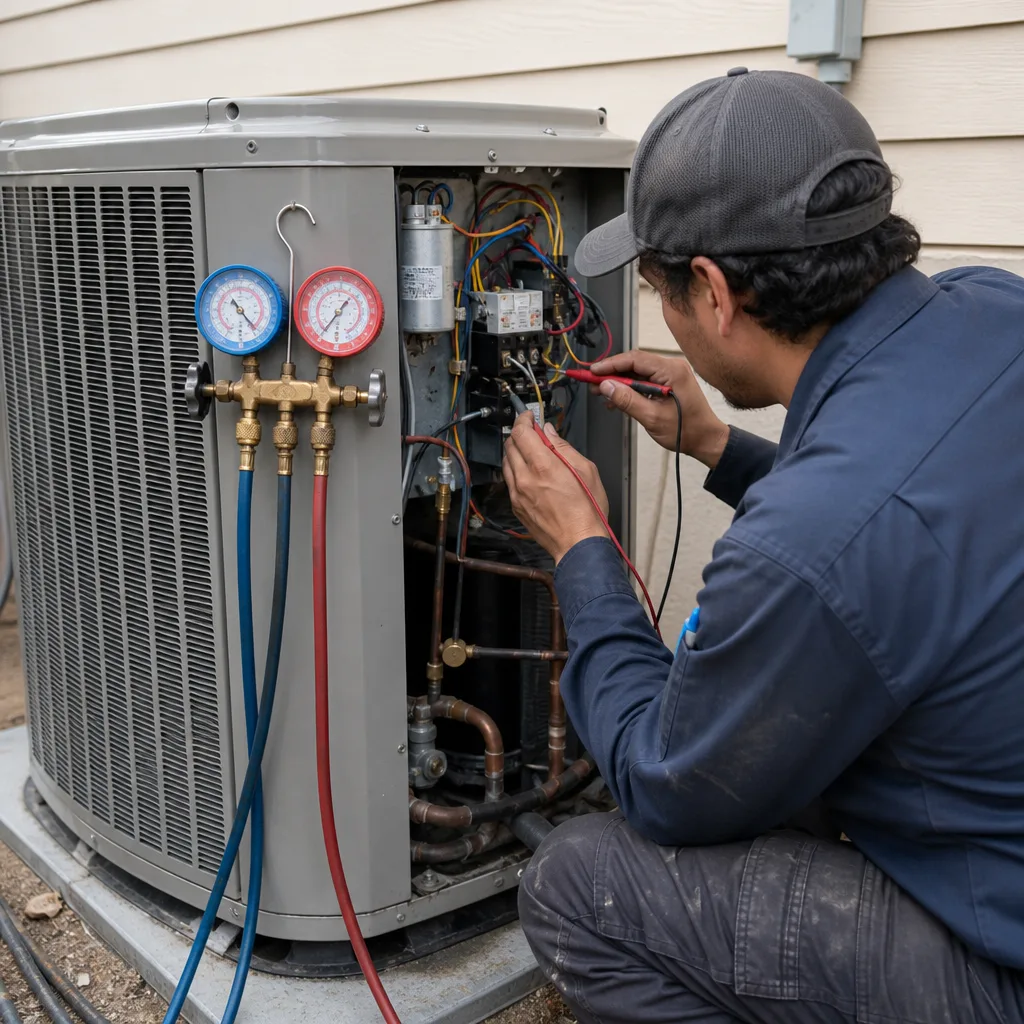
Luis Serrano and our Houston field team see these symptoms every single week during the cooling season. The fix is usually the same: test the microfarad reading with a capacitance meter, confirm the voltage rating, replace the part, and verify the fan and compressor come up to speed under a full heat load. It’s a 45-minute job when everything goes smoothly, and we quote it as such.
See the difference
 Before
 After
After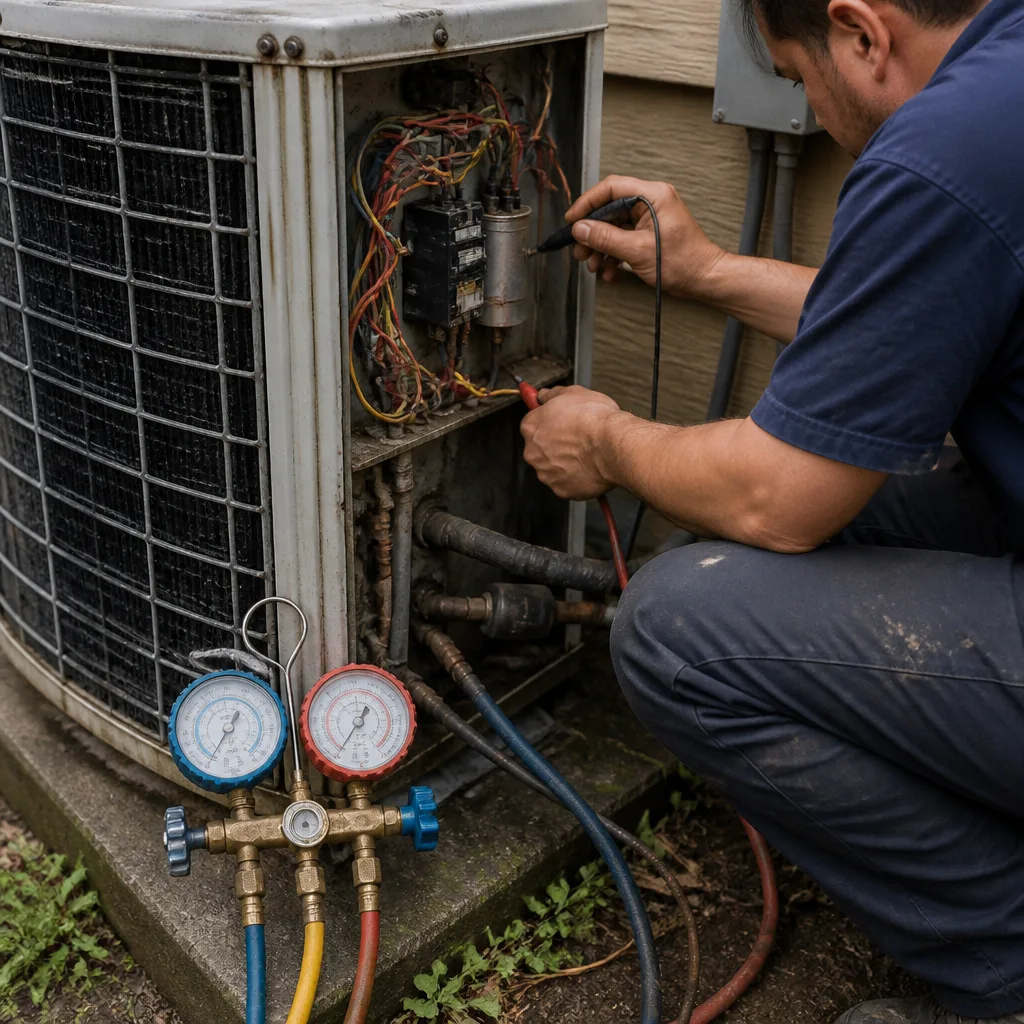 Before
 After
After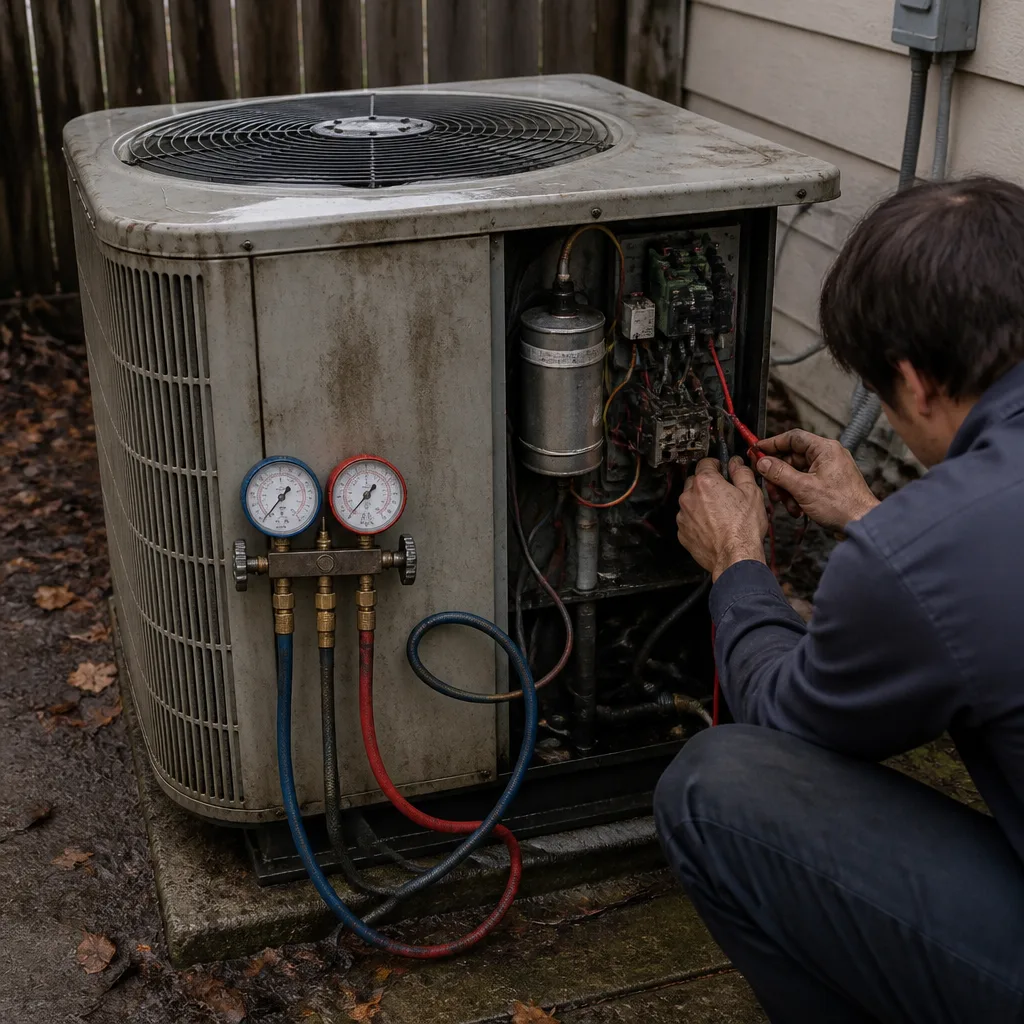 Before
 After
AfterReplacement Cost & What’s Included
In Houston, a Rheem capacitor replacement runs $150 – $375 installed. Most single-stage Rheem units with a standard 45/5 dual-run capacitor land right around $225 – $275 total, including the service call, the part, and the labor. Where you fall in the range depends on a few specifics: dual-run capacitors cost more than single-run, 440V-rated units cost slightly more than 370V, and start-assist configurations with a potential relay and separate start capacitor run toward the higher end because there’s more to test and replace. Our flat-rate price is written down and handed to you before any work begins, and it stays that price whether the job takes 45 minutes or two hours.
Every Rheem capacitor replacement we do includes a full system test before we leave: we verify the new capacitor’s microfarad reading under load, check the condenser fan amp draw, and make sure the compressor starts and runs cleanly. We also clean and tighten the spade terminals, which is a common hidden cause of capacitor failure people don’t mention. The work is covered by our 365-Day Done Right Promise: if something about the repair isn’t right within a year, we come back and make it right, no runaround and no fine print.
DIY or Call Us?
Here’s the honest split. You can safely go outside, make sure the breakers to the AC are off, and look through the condenser grille for a bulged capacitor. That visual check costs you nothing and tells us a lot before the first phone call. What you shouldn’t do is attempt the swap yourself. Capacitors store a charge even after power is disconnected, and a charged capacitor can deliver a serious shock if it discharges through you. You also can’t test the old part’s actual microfarad reading without a capacitance meter, and that reading is the only reliable way to confirm the diagnosis. We’ve been to Houston homes where a homeowner replaced a capacitor based on a guess and still had a dead unit, because the real problem was a burned wire terminal behind the capacitor they never saw.
“Tell me what the house is doing, and we’ll figure out what it actually needs.” That’s how Luis Serrano runs the calls. If you’ve noticed your Rheem acting up, call (346) 201-5395. We’ll ask you what you’re seeing and hearing, we’ll give you a straight answer about whether a capacitor is likely, and if it is, we’ll give you a written price before we touch anything.
FAQs
In Houston’s heat, a Rheem capacitor typically lasts 5 to 10 years, with 6 to 8 years being the most common failure window. The heat and humidity accelerate the breakdown of the dielectric fluid inside the capacitor, so Houston units tend to lose capacitors faster than systems in cooler climates. If yours is past year 7, the failure isn’t unusual, it’s on schedule.
No, a capacitor can’t be repaired. Once the dielectric fluid leaks or the internal plates degrade, the part is done, and the only correct fix is a replacement with matching microfarad and voltage spec. The good news is it’s a relatively inexpensive part, and replacement takes under an hour in most cases. Call (346) 201-5395 and we’ll quote the exact price for your unit.
A straightforward Rheem capacitor replacement usually takes 45 to 60 minutes from arrival to a running system, including the post-repair test to confirm the compressor and fan are starting cleanly. If we find corroded terminals or a start-assist relay that also needs attention, we’ll show you and give you a new written price before doing any additional work.
Yes, we carry Rheem-compatible capacitors in the common microfarad and voltage ratings on every service truck, including the 45/5 dual-run caps that cover the majority of Rheem residential condensers in Houston. We also stock parts for Carrier, Trane, and Lennox units, so if you have a mixed-brand house like plenty of Houston homes do, we can handle it in one stop. If your unit needs an unusual spec, we can almost always have it the same day from a local supply house.
If your Rheem capacitor has failed, don’t let a $200 part take down your whole summer. Meadowsweet Heating and Air Houston has the parts, the test equipment, and the written-price guarantee to make it right. Call (346) 201-5395 now for a free estimate, and a live person will answer, day or night.
Written by Luis Serrano, Owner, Meadowsweet Heating and Air Houston at Meadowsweet Heating and Air Houston, serving Houston and nearby areas.